Quick take
Fiber isn’t just one thing — it’s a family of plant compounds that behave differently in your body and your microbiome. Here’s how soluble, insoluble, and prebiotic fibers each play a role in gut health.
We often hear: "Eat more fiber".
But here’s the catch — fiber isn’t just one thing.
Nutrition labels may list “fiber” as a single number, but scientists know it’s a diverse family of compounds. How that fiber behaves in your body — whether it bulks up stool, feeds your microbes, lowers cholesterol, or steadies blood sugar — depends on its type and properties[^1][^2].
Let’s look at how scientists break it down.
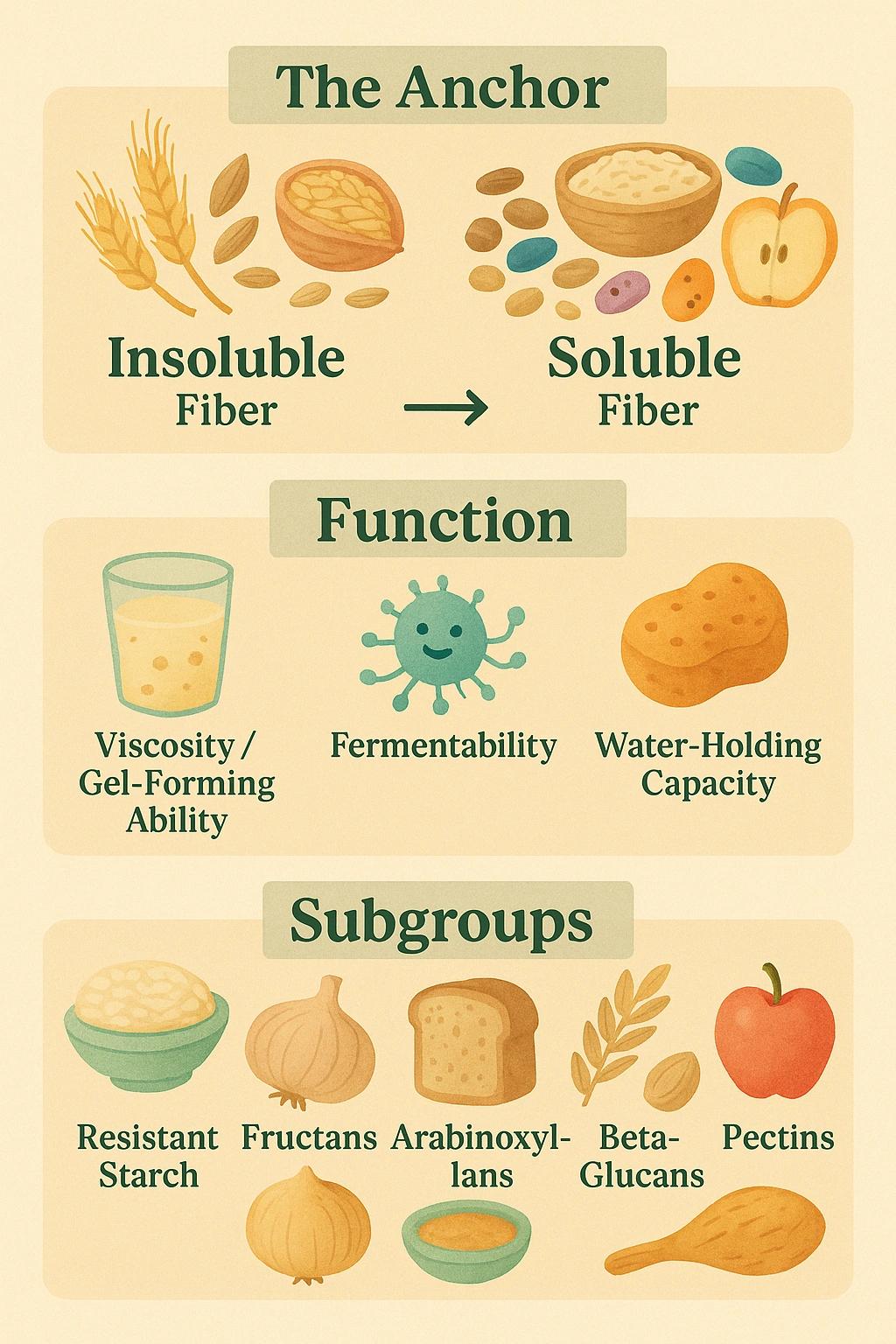
The Anchor: Soluble vs. Insoluble
This is the simplest and most widely used way to describe fiber[^1]:
- Insoluble fiber: doesn’t dissolve in water. Adds bulk and keeps bowels moving.
- Sources: wheat bran, rice bran, vegetable skins, nuts, seeds.
- Soluble fiber: dissolves in water. Some form gels, many are fermented by gut microbes.
- Sources: oats, beans, lentils, flaxseed, apples, citrus.
This anchor split is still helpful — but it’s only the surface layer. Within soluble and insoluble fibers, there’s much more nuance.
Looking at Function: Physicochemical Properties
Scientists often classify fiber by how it behaves in the gut[^2][^3]:
- Viscosity / Gel-Forming Ability
- Some soluble fibers form gels (like psyllium, beta-glucans, guar gum).
- Effect: slow down digestion, reduce cholesterol absorption, improve satiety.
- Fermentability
- Many soluble fibers (and resistant starch) are fermented by gut microbes.
- Effect: produce short-chain fatty acids (SCFAs) like butyrate → fuel for colon cells, anti-inflammatory effects[^4][^5].
- Water-Holding Capacity
- Some insoluble fibers (like wheat bran) hold water, increasing stool bulk and speed.
- Effect: prevent constipation, maintain regularity.
These functional lenses explain why different fibers feel and act differently in the body.
Looking at Source: Chemical Structure & Subgroups
Another way scientists describe fibers is by their chemical family or food source. These aren’t new “types” of fiber but subgroups that behave in distinct ways[^1][^2][^3]:
- Resistant Starch escapes digestion in the small intestine, ferments in the colon.
- Sources: cooked-and-cooled rice/potatoes, lentils, green bananas.
- Gut role: excellent butyrate producer, strengthens gut lining[^5].
- Fructans (Inulin, FOS) are Prebiotic fibers that selectively feed Bifidobacteria[^6].
- Sources: onions, garlic, leeks, asparagus, chicory root.
- Gut role: boost microbial diversity and immune function.
- Arabinoxylans are found in cereal grain cell walls.
- Sources: whole wheat, rye, barley.
- Gut role: fermentable, support SCFA production, improve metabolic health
- Beta-Glucans are soluble, viscous fibers.
- Sources: oats, barley, mushrooms.
- Gut role: lower cholesterol, steady blood sugar, support immune system[^2][^3].
- Pectins are common in fruits.
- Sources: apples, citrus, guava.
- Gut role: fermentable, improve stool consistency, support microbiota.
- Mucilage (Gel-Forming) are sticky, viscous fibers.
- Sources: psyllium husk, flaxseed, fenugreek, okra.
- Gut role: slow glucose absorption, soothe the digestive tract.
How Fiber Feeds Your Microbiome
When gut microbes ferment certain fibers, they produce short-chain fatty acids (SCFAs) — mainly acetate, propionate, and butyrate[^4][^5].
These compounds are more than digestive by-products:
- Butyrate fuels colon cells and supports a healthy gut barrier[^4].
- Propionate helps regulate blood sugar and cholesterol[^5].
- Acetate travels through the bloodstream, influencing metabolism and appetite[^5].
Though the three above dominate (>95%), microbes also produce smaller amounts of:
- Valerate (C5) – from protein fermentation or certain oligosaccharides; may have barrier-supportive effects.
- Isobutyrate & Isovalerate – branched-chain fatty acids from amino acid fermentation (valine, leucine, isoleucine).
- Caproate (C6) – very minor, linked to specific microbial species.
These minor SCFAs often signal shifts toward protein fermentation or dysbiosis rather than fiber-rich fermentation[^5].
Together, they act like tiny molecular messengers — linking your diet, microbes, and overall well-being[^5].
That’s why fiber diversity = microbial diversity = resilience.
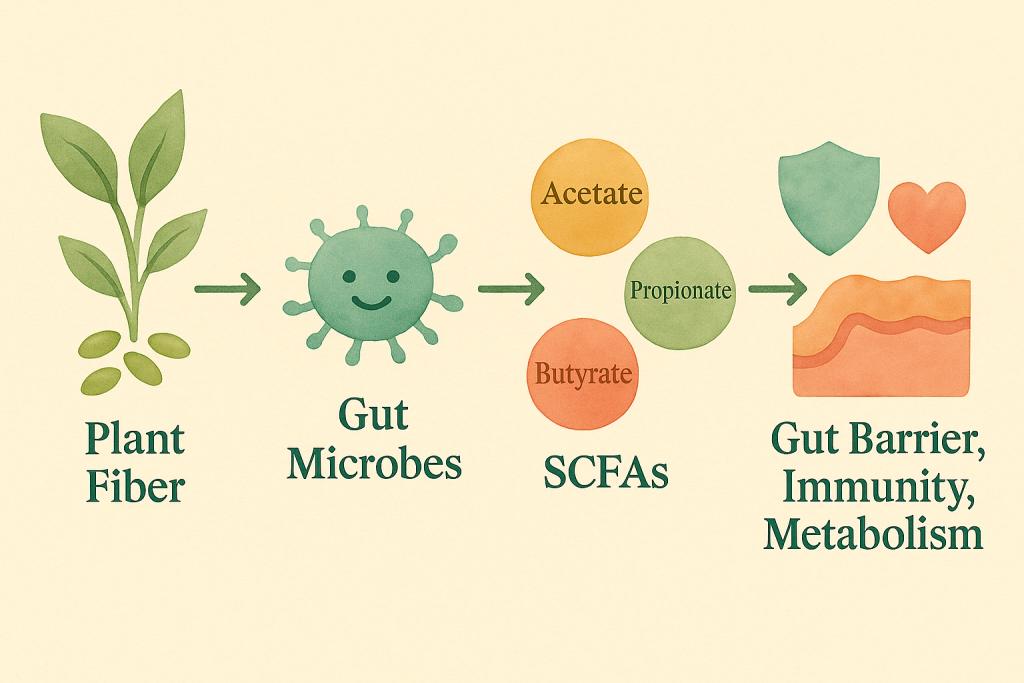
Each family speaks a different dialect of “fiber”—and your gut thrives when it hears them all.
Why This Matters for Gut Health
Seeing fiber through these lenses helps explain:
- Why bran helps you poop but doesn’t feed microbes much.
- Why oats lower cholesterol while garlic boosts microbial diversity.
- Why yesterday’s rice can strengthen your gut lining in a way fresh rice doesn’t[^2][^5].
No one fiber does it all. Your gut thrives on exposure to many types across the week — even in small amounts.
Practical Ways to Build Fiber Diversity
So how do we bring all these fibers to the plate?
- Rotate grains: rice, oats, barley, millets.
- Pair legumes with veggies: dal with spinach, chole with onions and garlic.
- Try the cool-down trick: yesterday’s rice → today’s resistant starch.
- Use traditional foods: idli with chutney, sarson ka saag, thalipeeth — these dishes naturally layer multiple fiber subgroups.
- Increase gradually and hydrate to avoid bloating.
Closing Nourishfully Note
Fiber isn’t filler.
It’s structure, signal, and food for your inner ecosystem.
By understanding fibers through different lenses — soluble vs insoluble, functional behavior, and chemical subgroups — we see why a rainbow of plant foods matters.
Every plant, every fiber, adds to the rhythm of resilience.